In today’s fast-moving business environment, the question of “how should we hire?” is no longer merely a cost-related decision. It has become a strategic consideration that directly impacts long-term competitiveness.
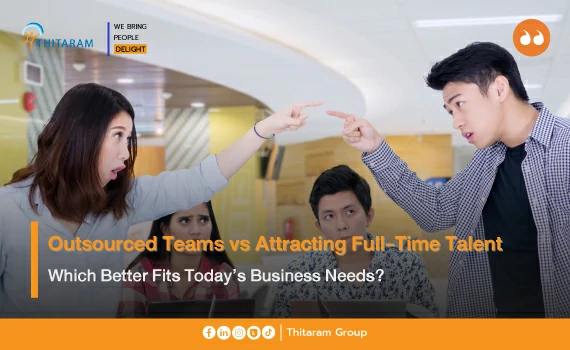
There is no absolute answer as to whether an Outsourced Team or Full-Time Talent is inherently better. The real answer lies in which approach best aligns with a company’s context, objectives, and stage of growth at a given time.
Traditionally, having a large permanent workforce was often seen as a symbol of organizational stability. However, in the modern business landscape, growth is no longer measured by headcount alone. Organizations increasingly prioritize speed, expertise, and flexibility to keep pace with constantly evolving market conditions.
This does not mean that full-time talent has lost its importance. On the contrary, core roles that drive organizational culture and long-term direction—such as leadership positions, strategic specialists, and roles requiring continuity—still depend on employees who grow alongside the organization.
That said, attracting and retaining full-time talent comes with significant challenges: lengthy recruitment processes, long-term cost commitments that require careful planning, and risks associated with hiring decisions that may not align with business direction. These are realities that modern organizations cannot avoid.
Outsourced Teams: From Tactical Option to Strategic Advantage
Outsourced teams are no longer limited to short-term problem-solving. They have become a strategic lever for enhancing organizational capabilities. Companies can deploy outsourced teams in situations such as:
- Roles requiring specialized expertise
- Projects with a defined timeline
- Businesses that need to scale teams up or down rapidly
- Functions where cost control and risk management are critical
The key advantage is the ability to access the right capabilities immediately, without carrying long-term fixed costs.
Modern Businesses Don’t Choose Sides — They Combine Both
Organizations that adapt well in today’s environment typically do not ask which model to choose, but rather:
“Which roles should be core, and which should be flexible?”
- Core Team (Full-Time): Responsible for strategy, culture, and key decision-making
- Flexible Team (Outsourced): Adds expertise, speed, and operational agility
This blended approach enables sustainable growth without unnecessary risk.
Thitaram Group’s Outsourced Teams: A Flexible Choice for Forward-Thinking Businesses
At a time when many organizations are carefully considering whether to expand their permanent workforce or preserve flexibility, decisions around people have become more complex than ever. Thitaram Group’s Outsourced Team solutions are designed to help organizations move forward with confidence—without taking on excessive burden. This is not merely about staffing; it is about partnership. Thitaram Group works closely with clients to think strategically, plan workforce structures, analyze manpower requirements, define roles aligned with business direction, and manage labor law compliance and HR operations comprehensively. This allows organizations to focus fully on what matters most.
Outsourced Teams are particularly suitable for organizations that want to:
- Launch new projects or expand teams quickly without lengthy hiring processes
- Access specialized skills as needed, without immediate long-term employment commitments
- Reduce HR-related risks and costs, including labor law compliance
- Adjust team size in line with constantly changing business conditions
In a business world defined by speed, having a team that can adapt is just as important as having a team that is highly skilled. Thitaram Group’s Outsourced Teams are one of the tools that enable organizations to design a future-ready workforce with confidence.
Conclusion
Modern businesses do not need to be tied to a single employment model. Instead, they should design workforce structures that align with their goals at each stage of growth. Organizations that achieve sustainable success are those that strategically combine full-time teams and outsourced teams, while partnering with providers who truly understand their business and can move forward with them through every phase of change.