As business competition intensifies, organizational expectations of HR have shifted significantly. HR is no longer viewed merely as a support function handling documentation or administrative processes. Instead, it is expected to act as a strategic partner that helps drive sustainable organizational growth.
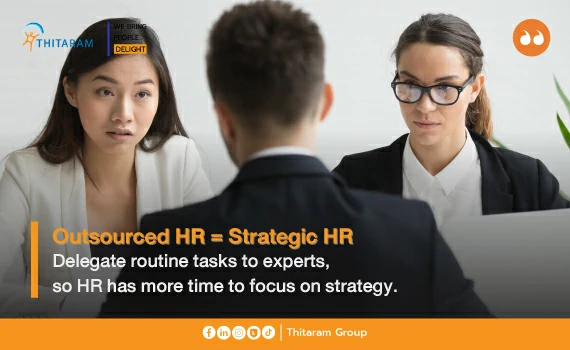
The critical question, however, is whether HR truly has sufficient time to think strategically—when daily responsibilities are dominated by routine tasks such as payroll processing, labor documentation, contract management, preliminary recruitment, and navigating increasingly complex labor law issues. This reality has led many organizations to embrace the concept of Outsourced HR = Strategic HR.
When HR Is Trapped in Routine Work, Strategy Becomes Secondary
Many organizations want HR to play an active role in workforce planning, talent development, and designing organizational structures and cultures that support growth. In practice, however, many HR teams spend the majority of their time on essential but non-strategic tasks.
These tasks must be executed accurately, compliantly, and in accordance with labor laws, yet they do not require high-level strategic decision-making. As a result, HR often becomes a function that is extremely busy, but with limited impact on organizational advancement.
Outsourced HR: From Reducing Workload to Elevating the HR Role
In today’s working environment, outsourcing HR functions does not diminish the role of in-house HR teams. Instead, it unlocks their true potential by allowing them to focus on value-creating activities.
HR functions that are well-suited for outsourcing include:
- Payroll and compensation management
- Employment documentation and contract administration
- Labor law compliance and regulatory management
- Recruitment requiring speed or high volume
- HR operations requiring accuracy and standardization
Strategic HR Is Not About Doing Everything — It Is About Choosing What Matters
Organizations that adapt successfully today do not measure strength by handling everything internally. They succeed by knowing what to retain in-house and what to entrust to specialists—and HR is no exception.
- Work requiring cultural continuity and strategic decision-making should remain with the Core HR Team
- Work demanding technical expertise, precision, and continuous legal updates is often better handled by Outsourced HR providers
This balance transforms HR into a system designer, rather than a team overwhelmed by operational burden.
Thitaram Group’s Outsourced HR: A Partner That Understands Strategic HR
Thitaram Group’s Outsourced HR services are designed to support both HR teams and executives—not only operationally, but strategically and from a risk-management perspective.
We do not view Outsourced HR as merely executing tasks on behalf of clients. We work as a strategic partner, helping organizations to:
- Analyze workforce structures aligned with business direction
- Manage HR operations and labor law compliance comprehensively
- Reduce HR workload, risks, and hidden costs
- Enable in-house HR teams to focus fully on strategic responsibilities
Thitaram Group does not replace internal HR teams. Instead, we relieve them of daily operational burdens so they can focus on what truly matters—planning, designing, and driving the organization forward with confidence under a compliant labor framework.
Conclusion
Strategic HR does not emerge from giving HR more work to handle. It emerges from making deliberate choices about which responsibilities should be delegated to experts—so HR can dedicate time to its most critical role: designing people strategies aligned with the organization’s future.
In a fast-changing business world, competitive advantage does not belong to organizations that try to do everything themselves, but to those that choose the right partners and manage human capital strategically.